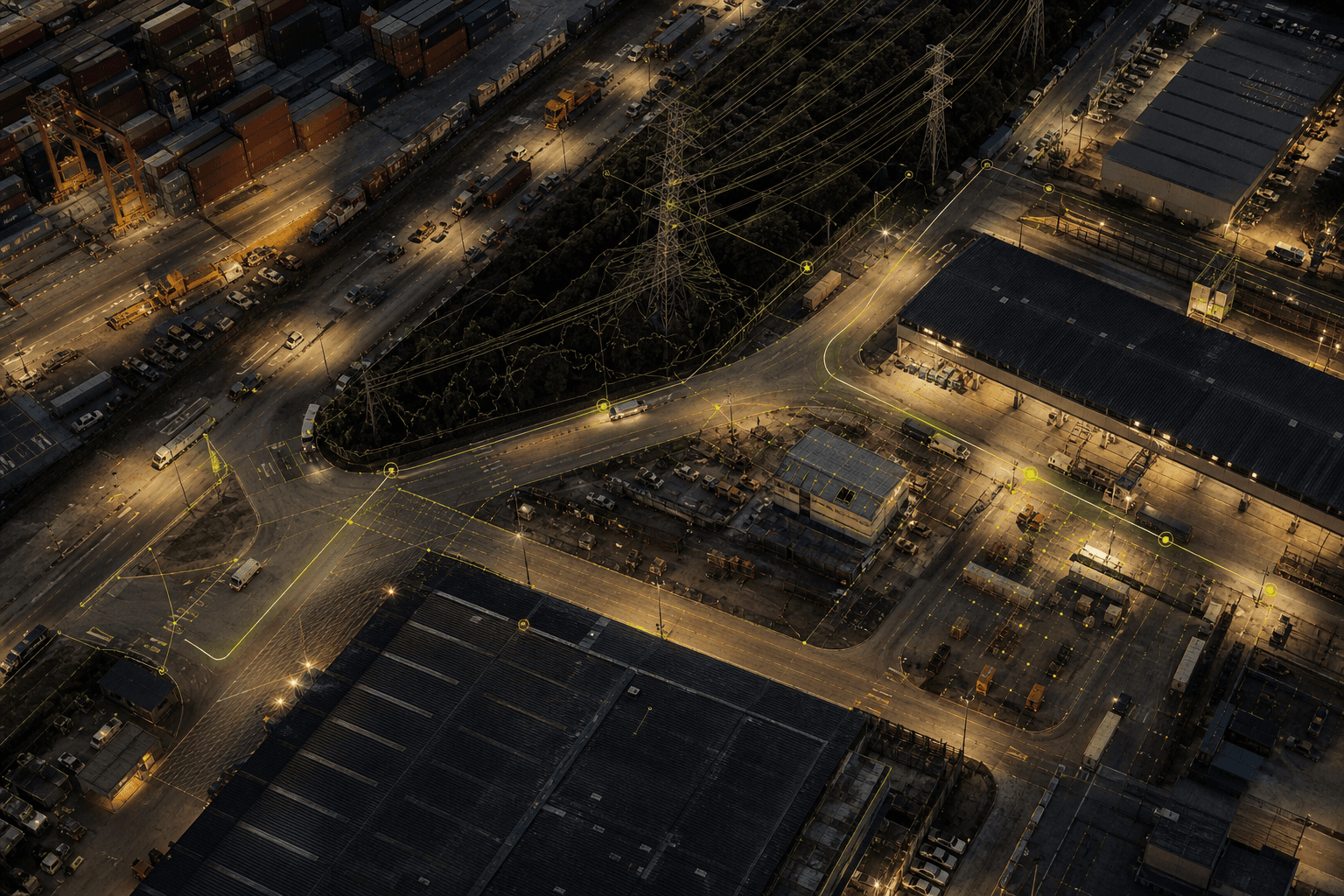
Procurement agent
Compare vendors, normalize bids, flag leakage, and route the final decision to the purchasing owner.
- Sourcing cycle time
- Purchase-price variance
- Leakage avoided
We deploy AI systems for procurement, quotations, inspections, permits, and collections—on top of the tools you already use.

Five repeatable systems. Each starts with the operational result—not the technology.
Compare vendors, normalize bids, flag leakage, and route the final decision to the purchasing owner.
Assemble scope, pricing, precedent, and approval rules while keeping a human accountable for margin.
Turn images, video, notes, and standards into findings, priorities, and controlled follow-up.
Extract requirements, populate forms, validate evidence, and track every outstanding response.
Monitor aging, assemble evidence, draft follow-ups, and escalate exceptions to the account owner.
Choose a sector to see four systems we would evaluate first.

Normalize commercial and technical bids before award.
Turn images and notes into prioritized corrective action.
Validate evidence before forms enter the approval queue.
Match claimed work to approvals and operating evidence.
We begin with controlled access and deploy above the tools your teams already trust.
No rebuild. No replacement. Controlled access first.
Build an operation that gets smarter.
Map one recurring decision, establish the baseline, and choose the metric that matters.
Test a working system on real operational data with the people who own the result.
Connect the controls, approvals, and integrations required to run it safely.
Retain approved context, rules, and evaluations so the next system starts smarter.

Documents, images, approvals, commercial history, and field evidence become faster decisions—with an accountable operator still in control.
Prior work proves delivery speed and AI system judgment. Your first operational proof validates the workflow baseline.
Retrained 1,000+ developers and supported AI strategy across treasury, controllers, legal, and document QA workflows.
Dense manuals and SOPs turned into publishable courses with lessons, quizzes, assessments, and simulations.
Slack, HubSpot, Airtable, and meeting data turned into live client risk flags and bi-weekly account intelligence.
“Kenji brings deep AI fluency, but what stands out most is his judgment. He knows which problems are worth solving, and he cares enough to get them right.”
Models, tools, regulations, and unit economics will keep changing. We stay close to the systems we deploy, translate what matters, and improve the operation without turning every advance into a new transformation project.

AI will not stand still. Your operating advantage should not either.
A long-term AI partner, not a one-off prototype team.Review the material shifts in models, infrastructure, deployment patterns, and governance.
Test what earns a place in your operation against the outcome, evidence, and controls you already own.
Refresh the workflow, train the team, and use every approved improvement as a stronger starting point.
No. We begin above your existing ERP, documents, communications, cameras, and operating tools. Replacement is never the default assumption.
We look for a recurring decision with an owned baseline, accessible evidence, a clear approval path, and enough economic consequence to justify deployment.
Yes. Access, hosting, retention, review, and write-back controls are designed around the workflow. Early proofs can begin with exports or read-only access.
Not by default. High-consequence actions remain drafted, reviewed, and approved by the accountable operator until the control case earns a wider boundary.
The agreed workflow assets, context, evaluation rules, integrations, and deployed system defined in the engagement—not a dependency on unexplained prompts.
When the right answer reaches beyond one workflow, we can design and deliver the underlying AI capability too.

Run suitable language and vision models inside the environment, network, and control boundary your operation requires.
Create living operational models that connect assets, constraints, scenarios, and decisions before they play out in the field.
Build models around the signals, outcomes, and edge cases that generic software cannot learn for you.
Collect, normalize, and maintain external and internal data so agents work from current, usable evidence.
Reroute, cache, and right-size inference to reduce AI costs by up to 90% where workload and architecture support it.
Train teams, operators, and leaders to use new AI systems with better judgment, adoption, and control.
Design the document, field, image, sensor, and human-feedback loops that make an AI system more useful over time.
Need something outside this list? Contact us for more details. Contact ↗